


Where Do Vintage Resellers Source Their Inventory? A Manual for Scaling Your Shop
TL;DR
- Successful resellers source from thrift stores, estate sales, and bulk wholesale suppliers like Thrift Vintage Fashion.
- Wholesale buying in bulk pounds (lbs) is the most efficient way to scale and lower the cost per garment.
- Upcyclers utilize "unsellable" grade items to create high-value products, maximizing profit from every shipment.
The reality is a mix of grit, logistical planning, and knowing how to handle bulk shipments. I look at every pound of fabric as raw potential. Whether you are hunting for Mickey/Disney T-Shirts to flip on Depop or looking for heavy denim to chop up into patchwork totes, your sourcing strategy dictates your hourly wage. If you spend five hours driving to three thrift stores and come back with four shirts, you aren't a business owner; you're a shopper.
To bridge the gap between "picker" and "professional," you have to understand the tiers of the secondary textile market. From the local bins to international wholesale vintage clothing mixes, here is exactly how the industry moves inventory in 2026.
Where do vintage resellers source their inventory for maximum profit?
Vintage resellers source their inventory through four primary channels: local thrift stores, estate sales, online marketplaces, and bulk wholesale suppliers. While local picking offers high margins on individual items, bulk wholesale allows resellers to acquire inventory at a significantly lower cost per pound, which is essential for scaling a high-volume business.
The Local Hustle: Thrift Stores and Bins
Most of us started here. I remember my first "profit per hour" calculation on a stack of 90s flannels I found at a local charity shop. After cleaning, photographing, and listing, I realized my "hourly rate" was less than minimum wage because of the travel time. However, thrift stores are great for finding "grails"—those high-value single pieces like a vintage Carhartt Detroit jacket that can fetch $200+.
The "Bins" (outlet centers where clothing is sold by the pound) are the next step up. Here, you are paying roughly $1.50 to $2.50 per lb. It’s hard work, and you will see me there with gloves on, looking for specific textile weights. I’m not just looking for brands; I’m looking for heavy cotton and sturdy zippers that I can salvage even if the garment is stained.
Estate Sales and Private Buy-outs
This is where you find the untouched "deadstock" or well-preserved vintage. Estate sales refer to the liquidation of a person's belongings, often including decades of clothing stored in attics or closets. It is time-consuming but offers the highest "hit rate" for authentic 1970s and 80s pieces. I’ve seen resellers buy out entire wardrobes for a flat fee, which is a great way to get a curated aesthetic quickly.
How do professional resellers buy in bulk?
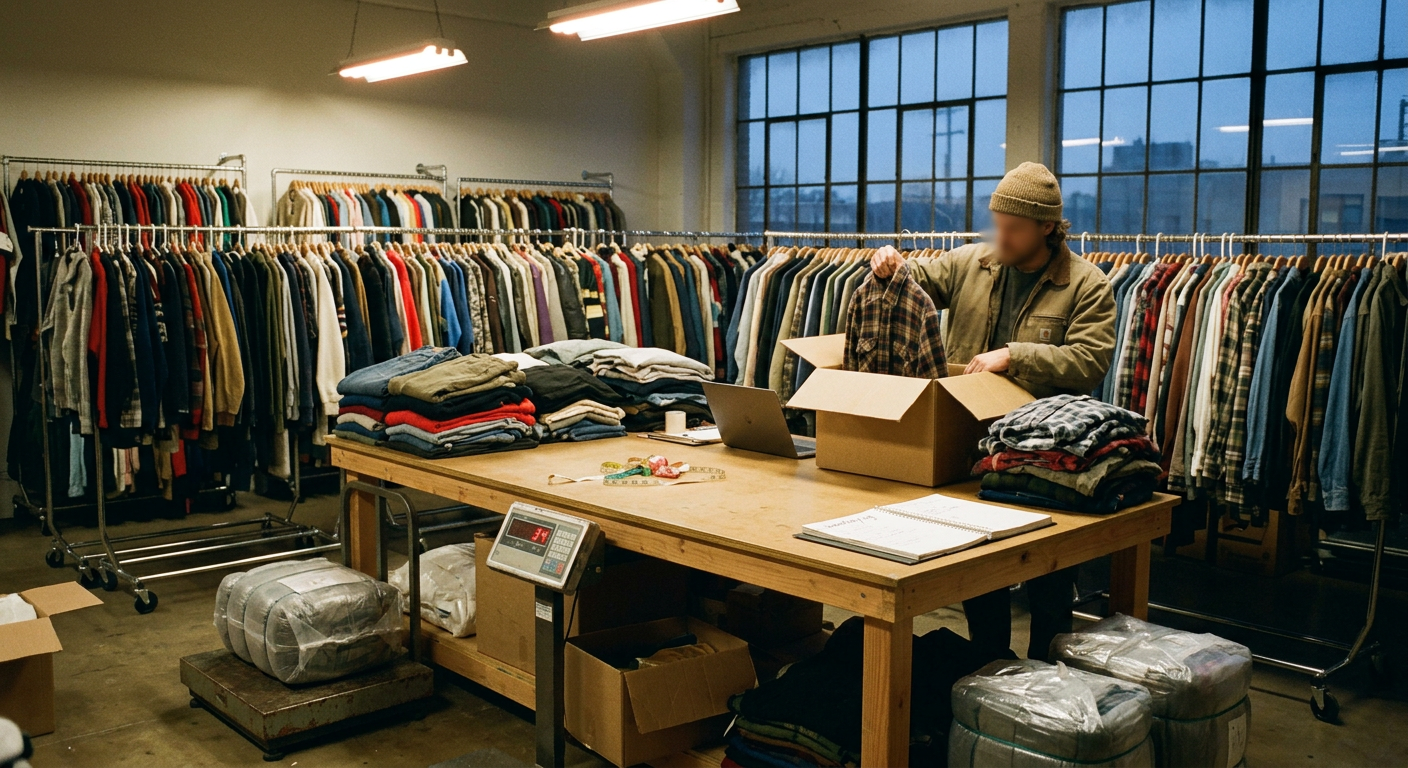
Professional resellers buy in bulk by partnering with wholesale distributors who sort and grade clothing into categories, selling them in boxes or large bales. Buying wholesale allows a shop to maintain a consistent aesthetic—such as "Gorpcore" or "90s Streetwear"—without having to physically find each item individually.
Understanding the Wholesale Grading System
Wholesale isn't a "bag of luck" if you do it right. It’s about grading. Grade A means the item is in excellent condition with no major flaws. Grade B might have a small stain or a tiny hole—these are my favorite. Why? Because the price per lb drops significantly, and as someone focused on creative reuse, a small hole is just an opportunity for a visible mend or a screen-printed patch.
For example, when looking at Wholesale Vintage Tees, a reseller can choose specific categories. This narrows the "crap-to-gold" ratio. If you buy a Rock & Music T-Shirts Mystery Box, you know the floor of your value because the category is already defined.
The Math of the Bale
A "bale" is a large, highly compressed bundle of clothing, usually weighing 100 lbs or more.
- 100 lb Bale of Mixed Tees: Approximately 200-250 shirts.
- Cost per Shirt: If the bale is $400, your cost per item is roughly $1.60 to $2.00.
- Processing Time: It takes about 10 minutes per item to steam, photograph, and list.
- Profit Ceiling: If you sell a shirt for $25, your gross profit is over $20 per unit.
What are the best clothing categories for resellers in 2026?
The best clothing categories for resellers currently include oversized vintage graphic tees, "Gorpwear" (technical outdoor gear), 90s workwear, and collegiate apparel. These categories have high sell-through rates on platforms like TikTok Shop and Depop because they fit the current "vintage-utility" aesthetic.
I personally track the demand for collegiate gear. A College & University T-Shirts Mystery Box is a staple for many of our partners because the branding is evergreen. From an upcycling perspective, I love workwear. A thrashed pair of Carhartt pants might be "unsellable" to a boutique, but I can cut them into panels for a reconstructed tote bag that sells for $150. That is how you turn a $5 investment into a triple-digit return.
| Category | Sourcing Method | Avg. Cost per Unit | Potential Resale |
|---|---|---|---|
| Graphic Tees | Wholesale Bales | $2 - $5 | $25 - $60 |
| Workwear Jackets | Wholesale Mixes | $15 - $30 | $80 - $150 |
| Collegiate Sweats | Bulk Boxes | $5 - $10 | $35 - $50 |
| Designer Mix | Hand-picked | $20 - $50 | $100+ |
Why is wholesale sourcing more sustainable than new inventory?
Wholesale sourcing is more sustainable because it utilizes the existing "waste stream" of the fashion industry, preventing millions of pounds of clothing from entering landfills. By cleaning, repairing, and reintroducing these garments into the market, resellers contribute to a circular economy that reduces the demand for new textile production.
I’ve written before about how the donation model is broken. When you buy wholesale from us, you are intercepting items that might otherwise be shipped overseas or shredded. My work involves taking the "Grade C" items—the stuff too damaged for a regular reseller—and giving them a second life. If you are a reseller, you are essentially a filter for the planet, catching the good stuff before it disappears.
How to prep wholesale inventory for sale?
If you want to be successful, you can't just flip a bale onto your floor. You need a process. I call it the "TVF Triage":
- Sorting: Separate the "ready to wear" from the "needs work."
- Cleaning: Use heavy-duty steamers. For stains in bulk, I’ve found that a 24-hour OxiClean soak in a plastic tub works wonders for 90% of cotton tees.
- Repair/Upcycle: This is my specialty. If a sleeve is blown out, crop the shirt. If a zipper is broken on a denim jacket, replace it with a heavy-duty brass one.
- Photography: Content is king. Modeling the clothes or using high-quality flat lays is non-negotiable in 2026.
Summary of Sourcing Success
The journey of a vintage reseller usually starts at a local thrift store, but it ends at a warehouse. To scale, you must move toward bulk sourcing. It reduces your travel time, lowers your cost per item, and gives you a steady stream of "raw material" to work with. Whether you are selling as-is or cutting garments up to make something new like I do, your inventory source is the heart of your business.
Frequently Asked Questions
Where do vintage resellers source their inventory? Most professional resellers source their inventory from wholesale suppliers, thrift outlet bins, estate sales, and private collections to maintain a high volume of stock. Wholesale suppliers are the most common source for those looking to scale an online or physical storefront.
What is a vintage clothing bale? A vintage clothing bale is a large, compressed bundle of used apparel, typically weighing around 100 lbs, that has been sorted by category but not individually inspected for resale. Bales are the most cost-effective way to buy inventory in bulk for high-volume resellers.
Is buying wholesale vintage clothing worth it? Yes, buying wholesale is worth it for resellers who need consistent inventory and a lower cost per unit to maintain profit margins after shipping and platform fees. It allows the business owner to focus on marketing and sales rather than spending all their time physically hunting for individual items.
How do I find reputable vintage wholesalers? Reputable wholesalers like Thrift Vintage Fashion provide transparent grading, clear category descriptions, and documented shipping processes. Look for companies that have a history in the textile industry and offer specific "mixes" rather than completely random unsorted rags.
If you are ready to stop hunting and start scaling, check out our latest Brand Name Mix at Thrift Vintage Fashion. We do the heavy lifting of sorting so you can focus on the creative and business side of your shop. Let’s keep these textiles out of the landfill and in the hands of people who appreciate them.