


What is the Best Way to Source Inventory for a Thrift Store?
TL;DR
- Wholesale Bales: Buying in bulk (100 lbs+) offers the lowest price-per-piece and highest profit margins.
- Strategic Categorization: Narrow your focus to high-demand niches like Wholesale Vintage Tees or Gorpcore to speed up turnover.
- Consistency over Cherry-picking: Reliable suppliers beat the "thrift store hunt" by providing predictable volume for scaling.
- Quality Control: Professional grading ensures you aren't paying for "filler" or damaged goods that can't be sold.
The most successful partners I work with at Thrift Vintage Fashion shifted their mindset years ago. They stopped looking for individual items and started looking for systems. I remember one seller, Sarah, who was stuck at $2,000 in monthly sales because she couldn't find enough inventory to keep up with her Poshmark demand. Once she switched to Wholesale Vintage Clothing Mixes, her volume tripled because she spent her time listing and marketing instead of driving.
What is the best way to source inventory for a thrift store?
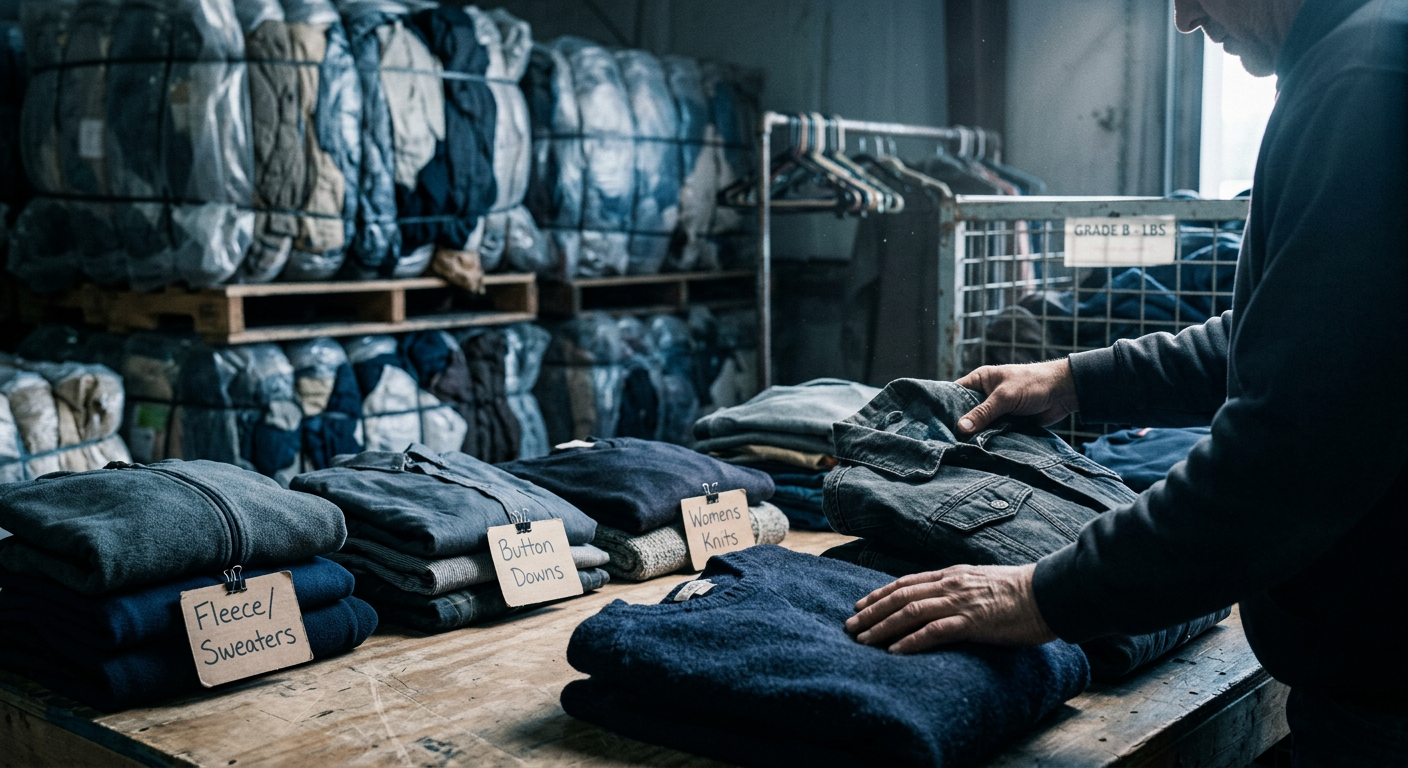
The best way to source inventory for a thrift store is to buy curated wholesale bales or mystery boxes from a reputable supplier. This method allows you to acquire high volumes of vintage apparel at a low cost-per-unit, typically ranging from $2 to $12 per piece, which ensures a sustainable profit margin when reselling at market value. By bypassing the time-consuming process of individual picking, you can focus on the "listing-to-sale" pipeline that actually generates revenue.
When I look at the data from our top 10% of resellers, they aren't sourcing one-by-one. They buy by the pound or by the box. Sourcing inventory refers to the process of identifying, vetting, and purchasing stock that will be sold to the end consumer. For a thrift store, this means securing a steady stream of "Grade A" items—clothing that is in good wearable condition with minimal flaws—without having to physically visit dozens of locations.
Why is wholesale sourcing better than traditional thrifting?
Wholesale sourcing is superior because it provides scalability and predictability that local thrift scouting cannot match. While local thrifting relies on luck and geography, wholesale sourcing allows a business to order specific categories, like vintage carhartt detroit jacket wholesale lots, in quantities that meet consistent customer demand.
In my experience, the biggest trap for new resellers is the "sunk cost" of travel. If you spend $40 on gas and 5 hours of your time to find 10 shirts, your real cost-per-item isn't just the $5 you paid at the register—it's closer to $20 when you factor in your labor. Our partners who buy Wholesale Vintage Clothing Bundles for Resellers tell me their favorite part is the "unboxing" efficiency. They receive 50-100 lbs of gear at their door, steam it, photograph it, and have it live on their shop within 48 hours.
How do you find the right wholesale vintage supplier?
Finding the right supplier requires vetting their grading standards, shipping transparency, and historical consistency. A reliable wholesaler should provide clear "Grade" definitions (e.g., Grade A vs. Grade B) and offer specific category mixes rather than generic "mystery bags" that might be filled with modern fast fashion.
I always tell my community: look for experts, not generalists. At Thrift Vintage Fashion, we don't just sell "old clothes." We curate based on what's actually moving on TikTok Shop and Depop right now. If a supplier can't tell you the difference between a 90s single-stitch tee and a 2010s reprint, they aren't the right partner for a vintage-focused store. We’ve seen resellers lose thousands by buying "vintage bales" from overseas suppliers that turned out to be 80% landfill-ready rags. Stick to USA-based suppliers who understand the Western vintage market and provide detailed grading guides.
Comparison: Sourcing Methods for 2026
| Sourcing Method | Time Investment | Cost Per Piece | Scalability | Best For |
|---|---|---|---|---|
| Local Thrift Stores | Very High | Medium ($5-$15) | Low | Hobbyists / Part-time |
| Estate Sales | High | Low ($1-$5) | Very Low | Curated High-End Vintage |
| Wholesale Bales (100 lbs+) | Low | Very Low ($2-$6) | Very High | Full-time Resellers / Stores |
| Mystery Boxes | Very Low | Medium ($8-$15) | High | Boutique Curators |
What are the most profitable categories to source in bulk?
The most profitable categories to source in bulk include 90s graphic tees, workwear (Carhartt/Dickies), and branded sportswear like Mickey/Disney T-Shirts. These items have high "sell-through" rates because they appeal to a wide demographic, from Gen Z fashionistas to nostalgic collectors.
I specifically track "Category Performance" for our reseller community. Last quarter, one of our partners who focuses on Rock & Music T-Shirts reported an average ROI of 400%. They bought a 50-piece box for roughly $500 ($10/shirt) and sold the majority for $40 to $60 each. Another surging category is "Gorpwear"—think vintage North Face, Patagonia, and technical outdoor gear. We’ve seen these items fly off the shelves on platforms like Instagram and TikTok because they fit the current "utilitarian" aesthetic.
How do you manage and prep bulk inventory?
Managing bulk inventory involves a four-step process: sorting, cleaning, photographing, and listing. Effective inventory management means tracking your "cost of goods sold" (COGS) for every bale and ensuring that even the lower-value items are processed quickly to maintain cash flow.
When a 100 lb bale arrives, don't get overwhelmed. I recommend my "3-Pile Method":
- The "Grails": High-value items (worth $50+) that get immediate professional photos and detailed descriptions.
- The Bread & Butter: Solid Grade A items ($20-$40 range) that make up the bulk of your daily sales.
- The Upcycle/Bargin: Items with small stains or holes that can be sold as "distressed" or used for bulk vintage denim upcycling.
Frequently Asked Questions
Where is the best place to buy vintage clothing for a Depop shop?
Professional resellers use wholesale suppliers like Thrift Vintage Fashion to buy themed bundles in bulk, which ensures a cohesive aesthetic and higher profit margins than individual thrifting.
What is a vintage clothing bale?
A vintage clothing bale is a highly compressed large volume of used apparel, typically weighing 100 lbs or more, sold at wholesale prices to resellers and store owners.
How much do wholesale vintage t-shirts cost?
Prices vary based on rarity and grade, but wholesale vintage tees generally range from $5 to $15 per piece when purchased in bulk boxes or bales.
Is buying vintage bales worth it for small resellers?
Yes, it is worth it if you have the space to process inventory, as the lower cost-per-item allows you to stay competitive on pricing while still making a profit.
How do I identify real vintage vs modern reprints?
Look for "single-stitch" hems on sleeves and waists, specific era-appropriate tags (like Screen Stars or Giant), and the feel of the fabric, which is often thinner and softer on genuine 80s and 90s items.
Scaling Your Thrift Business with Intent
If you want to move from "reselling as a side hustle" to "running a thrift empire," you have to stop thinking like a shopper and start thinking like a buyer. The best way to source inventory for a thrift store isn't finding the one-in-a-million item; it's finding the one-in-a-million partner.
I’ve seen dozens of shops go from struggling to pay rent to opening second locations because they finally mastered their sourcing. They leaned into bulk denim, they stocked up on College & University T-Shirts before the back-to-school rush, and they trusted the grading process.
Ready to stop wasting time in the bins? Let Thrift Vintage Fashion provide the high-quality, high-margin inventory you need to dominate the vintage market. Check out our current wholesale mixes and start scaling your shop today.