


Thrift Vintage Fashion vs. Ragstock Wholesale: Which is better for resellers?
TL;DR
- Thrift Vintage Fashion specializes in high-volume, category-specific bulk bales and mystery boxes for professional resellers seeking massive profit margins.
- Ragstock Wholesale offers a "pick your own" or small-batch approach, which is better for casual hobbyists or boutiques needing very specific, curated pieces.
- Profit Potential: Bulk sourcing from Thrift Vintage Fashion typically results in a lower cost-per-item, allowing for higher ROI on platforms like Depop and Poshmark.
The truth is, these two companies serve very different ends of the market. I’ve talked to partners who tried one and flopped, only to switch to the other and find their groove. Choosing between Thrift Vintage Fashion vs. Ragstock Wholesale: Which is better for resellers? depends entirely on whether you are looking for a curated "boutique" experience or a scalable, high-volume business model. Most of the top-tier sellers I work with realized early on that "hand-picking" every item doesn't scale.
If you are ready to stop hunting for individual items and start building an inventory machine, you need to understand how these two giants compare. I’m going to break down the actual numbers, the grading standards, and the sourcing strategies I’ve seen work for our community in 2026.
Thrift Vintage Fashion vs. Ragstock Wholesale: Which is better for resellers?
The choice between Thrift Vintage Fashion and Ragstock Wholesale depends on your business volume; Thrift Vintage Fashion is better for resellers who need bulk volume (100-lb+ bales) and the lowest possible cost-per-item, while Ragstock is better for small-scale buyers who prefer hand-picking specific items. Thrift Vintage Fashion focuses on the "unprocessed" bulk market where the highest margins are found, whereas Ragstock operates more as a traditional retail-to-wholesale bridge.
In my experience, resellers on Depop and Poshmark gravitate toward our Wholesale Vintage Tees because the variety allows them to populate a shop quickly. Ragstock, on the other hand, often appeals to those who are nervous about "mystery" inventory and want to see every piece before they buy. However, that security comes at a price—usually a much higher cost-per-unit that eats into your final profit.
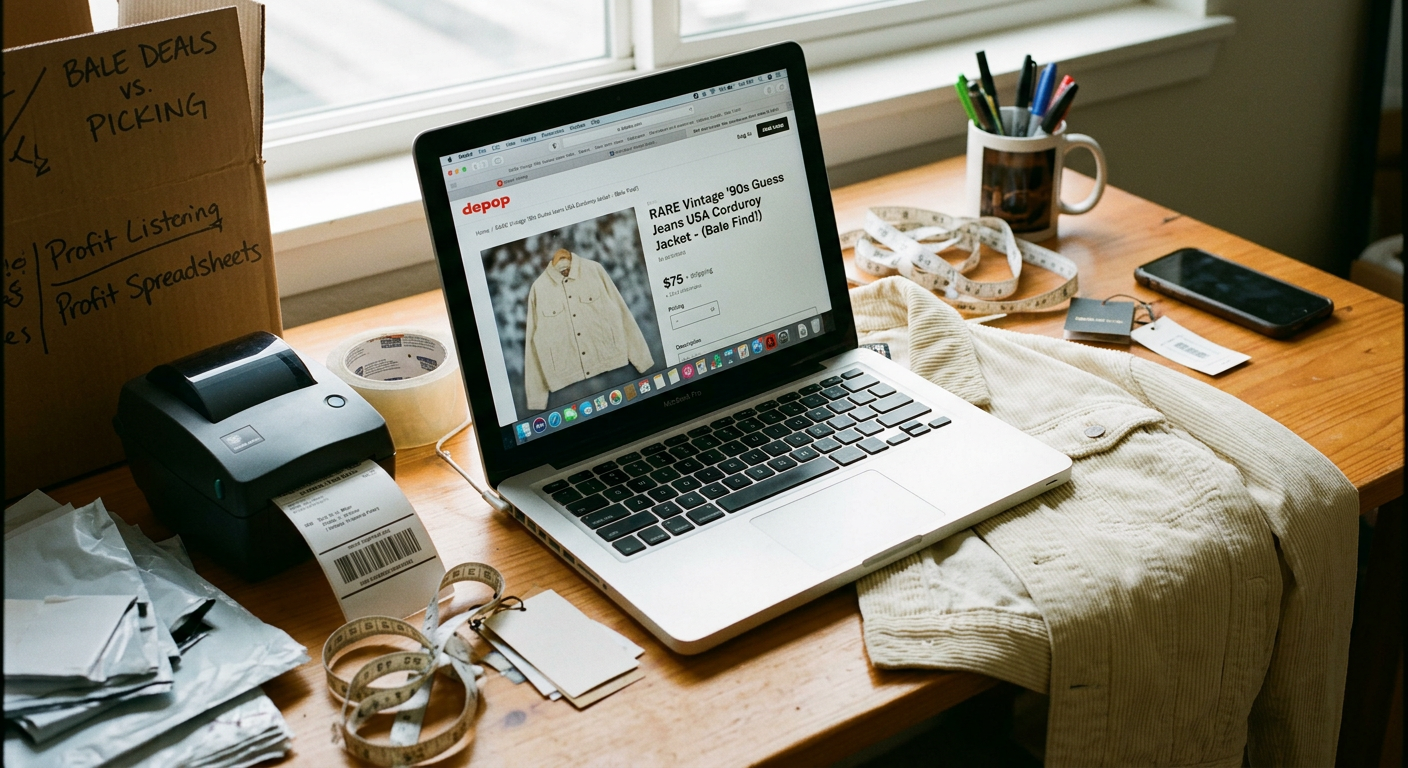
What is the difference in sourcing models?
The primary difference is that Thrift Vintage Fashion operates on a high-volume bale and mystery box model, while Ragstock emphasizes smaller, more curated "vintage bundles" and retail-style wholesale. A bale is a large, compressed bundle of clothing, typically weighing around 100 lbs or more, sold at a flat rate to maximize reseller margins. Ragstock tends to focus on lower quantities which is great for testing the waters, but harder to build a six-figure business around.
I recently spoke with a reseller named Sarah who switched from Ragstock to our bulk model. She was spending 10 hours a week hand-picking 50 items. After switching to a Brand Name Mix, she received 100 units in a single shipment. Her cost per item dropped from $12 to $4. Even though she had to spend more time cleaning and prepping, her net profit per hour of work nearly tripled.
How does the pricing compare for bulk vintage?
Thrift Vintage Fashion generally offers a lower cost-per-item by selling in 100-lb to 1,000-lb increments, whereas Ragstock’s smaller lots result in a higher per-unit price. For example, a 100-lb bale from us might contain 150-200 items, bringing the price-per-piece down to a fraction of what you would pay at a retail-wholesale outlet. This price gap is the "margin" that allows professional resellers to stay competitive on price-sensitive apps like TikTok Shop.
| Feature | Thrift Vintage Fashion | Ragstock Wholesale |
|---|---|---|
| Primary Unit | 100-lb Bales / 25-item Mystery Boxes | Small bundles / Hand-pick options |
| Best For | Scaling, High-volume, Full-time Resellers | Part-time hobbyists, Boutiques |
| Pricing Structure | Bulk weight-based (Lower per item) | Tiered lot pricing (Higher per item) |
| Inventory Type | Rare gems + Daily bread-and-butter | Curated trends |
Which supplier has better inventory for Depop and Poshmark?
Thrift Vintage Fashion is better for Depop and Poshmark resellers because the bulk bale model provides the "bread-and-butter" inventory—like Mickey/Disney T-Shirts—needed to maintain high listing frequency. Successful reselling is a numbers game; you need high-engagement "grails" mixed with consistent daily sellers. Ragstock's inventory is often pre-sorted for a specific aesthetic, which can be limiting if your shop caters to diverse trends like Gorpcore, Y2K, or 90s streetwear.
I’ve seen our community thrive by taking a mixed vintage kids bale and turning it into a specialized Instagram shop. When you buy in bulk, you get the variety that a "curated" lot simply can't provide. You get the unbranded "aesthetic" pieces that are currently exploding on TikTok Shop, which often have higher margins than the big-name brands because your buy-in cost is so low.
What are the risks of buying wholesale vintage bales?
The primary risk of buying wholesale vintage bales is "grade variance," which refers to the reality that every bulk lot will contain a mix of A-grade (excellent), B-grade (minor wear), and occasionally C-grade items. Grade variance is the industry-standard term for the fluctuation in quality within a bulk shipment. To mitigate this, we focus on transparent grading so resellers know exactly what to expect when they break a seal.
I always tell my resellers: the profit isn't just in the 10/10 items. The profit is in how you handle the B-grade. One of our most successful partners takes the "flawed" items from their Wholesale Vintage Clothing Mixes and sells them as "upcycled" or "distressed" projects. They actually make more on the distressed Carhartt jackets than the clean ones because the "worked-in" look is so hot right now.
How to maximize profit from your wholesale shipment
If you're making the jump from Ragstock to Thrift Vintage Fashion, you need a system. Sourcing is only 30% of the battle. The other 70% is how you process that 100-lb bale.
- The Fast Wash: Don't let inventory sit. As soon as that bale arrives, sort by "List Now," "Niche Clean," and "Repair."
- Strategic Pricing: Use the "Bread and Butter" strategy. Sell your common items at a price that moves inventory fast to recoup your initial investment. Everything else is pure profit.
- Cross-Platform Listing: Put your high-end vintage on Etsy or Depop, and your unbranded aesthetic pieces on Poshmark or TikTok Shop.
- Content is King: Use the unboxing of your 100-lb bale as content. Our resellers who film "Bale Break" videos on TikTok see 40% higher engagement.
Frequently Asked Questions
Is Thrift Vintage Fashion better for beginners?
Thrift Vintage Fashion is great for beginners who want to start with a modest investment through mystery boxes before graduating to 100-lb bales. It allows you to learn grading and market demand without huge overhead.
How much does a vintage bale weigh?
Most of our standard wholesale bales weigh approximately 100 lbs, containing anywhere from 80 to 200 items depending on the clothing category. We use pounds (lbs) to ensure shipping and inventory calculations are consistent for our USA-based resellers.
Can I choose the sizes in a wholesale bale?
No, wholesale bales are typically a "mill run" or mixed-size lot, which provides a natural distribution of sizes for your shop. This variety ensures you have something for every customer, which is critical for growing a following.
Does Ragstock or Thrift Vintage have faster shipping?
Thrift Vintage Fashion prides itself on efficient logistics for bulk orders, often shipping 100-lb units faster than boutique curators who have to hand-pick every item. We focus on getting inventory into your hands so you can start listing immediately.
What is the best category for high ROI?
In 2026, we are seeing massive returns on Rock & Music T-Shirts and 90s sportswear. These categories have high search volume and consistent sell-through rates on every major platform.
Final Verdict: Which should you choose?
If you are a casual seller who only wants to list 5 items a week, Ragstock might be your speed. But if you are looking to build a real business—a business that pays your rent and allows you to quit the 9-to-5—you need the scale of Thrift Vintage Fashion.
The resellers I see winning are the ones who embrace the volume. They aren't afraid of a 100-lb bale; they see it as 150 opportunities to make a sale. They understand that buying at $3-5 per unit is the only way to survive the rising fees on platforms like Depop and Poshmark.
Ready to scale your inventory? Browse our full collection of Wholesale Vintage Clothing and find the bale that fits your brand's aesthetic. Stop hunting, start selling. Case closed. Proudly sourced by Thrift Vintage Fashion.