


How to Source Inventory for a Thrift Store Business
TL;DR
- Wholesale Bales & Mixes: Buy in bulk (100 lbs+) to get the lowest cost per unit and scale quickly.
- Estate Sales & Bin Digging: High-margin but time-intensive; best for finding rare "grails."
- Online Sourcing: Use specialized vintage wholesalers for curated categories like Disney or Rock tees.
- Quality Control: Always factor in a 10-15% "dud" rate when calculating your potential profit margins.
In 2026, the market is louder than ever. You’ve got Depop sellers, TikTok Shop creators, and brick-and-mortar owners all fighting for the same rack space. To survive, you have to move away from "luck-based" sourcing and move toward a scalable supply chain. I’m going to break down exactly how I source, what the numbers look like, and which methods actually put money in the bank.
How do you source vintage clothing in bulk?
To source vintage clothing in bulk, you should partner with a wholesale supplier that offers graded categories or vintage clothing bales for sale. This method allows you to purchase 100-lb to 1,000-lb lots of specific items, like sweatshirts or denim, at a significantly lower price per unit than individual sourcing. By buying in volume, you secure a consistent stream of inventory without having to physically visit multiple thrift stores daily.
When I talk about bulk, I’m talking about Wholesale Vintage Clothing Mixes. For example, if you buy a mix of 50 pieces, you might pay $8 to $12 per item. If you jump up to a 100-lb bale, that price can drop even lower. I tell my clients all the time: "Stop looking for one shirt; start looking for one hundred."
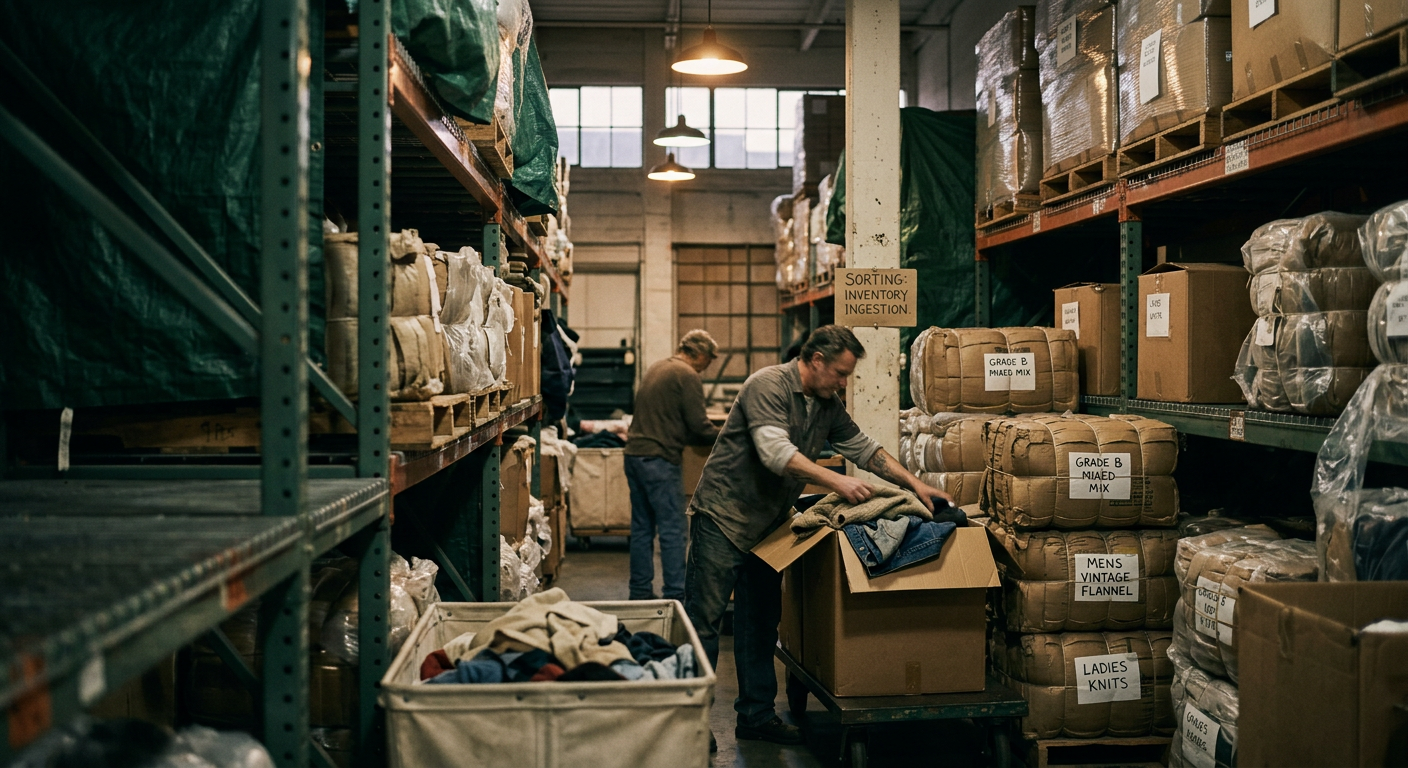
The reality of bulk sourcing: You will get some items that aren't winners. I call this the "grading reality." Even the best wholesalers have a small percentage of B-grade items in a bulk lot. However, the math works in your favor. If you buy a Brand Name Mix for $500 and find five "home run" items worth $100 each, the rest of the pile is pure profit.
What are the best inventory sources for a thrift store?
The best inventory sources for a thrift store include wholesale vintage suppliers, estate sales, rag houses, and online liquidated auctions. While wholesale suppliers provide the most scalability, estate sales are the best source for high-end "true vintage" pieces from the 1970s and earlier. Combining these methods ensures you have both a steady "bread and butter" stock and unique "hero" pieces to drive traffic.
1. Wholesale Suppliers (The Scalable Choice)
This is what we do at Thrift Vintage Fashion. We take the guesswork out of it. Instead of driving three hours to a rag house only to find out they don't have what you need, you order a specific category. If you need Mickey/Disney T-Shirts, you buy that specific pack. It’s the only way to keep a shop full.
2. Rag Houses (The High-Volume Choice)
A rag house is a massive warehouse where clothing is sorted for export or recycling. If you can get an appointment, you can often pick your own pieces (handpicking) or buy 1,000-lb bales. Warning: it’s dirty, hot, and physically demanding. Expect to pay $1.50 to $3.00 per pound, but you have to buy a lot of weight to make it worth their time.
3. Estate Sales (The Treasure Hunt)
I still love a good estate sale for the rare stuff. You aren't going to find a Rock & Music T-Shirts Mystery Box here, but you might find a single 1991 Nirvana shirt in a cedar chest.
| Sourcing Method | Cost Per Unit | Time Investment | Scalability |
|---|---|---|---|
| Local Thrift Stores | $5 - $15 | Very High | Low |
| Estate Sales | $2 - $20 | High | Medium |
| Wholesale Bales | $3 - $8 | Low | Very High |
| Rag Houses | $1 - $3 (by lb) | High | High |
Where can I find wholesale vintage clothing for a Depop or Poshmark shop?
You can find wholesale vintage clothing for Depop or Poshmark by using online wholesale platforms that specialize in "reseller-ready" bundles. These suppliers curate Wholesale Vintage Tees and other trendy categories like Carhartt or 90s sportswear specifically for the online aesthetic. Buying from a specialized wholesaler ensures the styles you receive actually match what is currently trending on social media.
For Poshmark and Depop, photography is everything. Your sourcing needs to reflect that. If you're selling to the "Gorpcore" crowd, you want to look for bulk vintage techwear and hiking gear. When I source for our College & University T-Shirts Mystery Box, I’m looking for that specific faded, cracked-print look that Gen Z is obsessed with.
One thing people get wrong: they think they have to find every item themselves to be "authentic." That’s a myth. Every major boutique you follow on Instagram is buying wholesale. They just don't tell you. They buy 100 lbs of Kids Mixed Bales because "vintage baby" is a huge niche right now, and they can't find enough of it at the local Goodwill.
How much does a vintage clothing bale cost?
A vintage clothing bale typically costs between $300 and $1,500 depending on the weight (usually 100 lbs) and the quality of the items inside. Prices vary by category; for example, a bale of basic t-shirts will be significantly cheaper than a bale of vintage denim or branded outerwear. On average, you can expect to pay between $2.00 and $7.00 per pound when buying by the bale.
Calculating your ROI (Return on Investment) on a bale is simple math. Let’s say you buy a 100-lb bale of sweatshirts for $600.
- Total Cost: $600
- Approx. Quantity: 80 pieces (at roughly 1.25 lbs per piece)
- Cost Per Piece: $7.50
- Average Sale Price: $25.00
- Potential Revenue: $2,000
- Profit after fees/shipping: ~$1,100
What is the best way to clean and prep wholesale inventory?
The best way to prep wholesale inventory is to perform a bulk wash and steam treatment followed by a rigorous inspection for stains or "vintage" odors. I recommend using a heavy-duty degreaser for pit stains and an ozone generator for pieces that have a persistent "thrift store smell." Once cleaned, every item should be measured and photographed under consistent lighting to ensure a professional presentation.
Sourcing is only half the battle. If you get a 100-piece lot from a wholesaler, you need a system. I see so many resellers let their inventory sit in bags for months (we call this a "death pile").
- Sort: Grade A (Ready to list), Grade B (Needs cleaning/repair), Grade C (Upcycling).
- Wash: Use a high-quality scent-booster. People want vintage, but they don't want it to smell like 1984.
- Steam: A steamer is better than an iron. It kills bacteria and makes the fabric look fresh.
- Tax Tracking: Don't forget that your inventory is a tax deduction. Keep your receipts from Thrift Vintage Fashion or any other wholesaler to track your Cost of Goods Sold (COGS).
Why the "Donation Model" is changing the way we source
It is important to understand that the old way of sourcing is dying. The traditional donation model, where everyone drops their clothes at a local bin and you go buy them for $1, is broken. Most of that stuff is now being diverted before it even hits the floor, or the prices are being jacked up to match eBay "sold" listings.
This is why I focus on the circular economy. By buying in bulk, we are redirecting massive amounts of clothing from landfills and getting them back into the hands of people who will actually wear them. It’s better for the environment, and it’s the only way to build a real business in 2026.
Frequently Asked Questions
How do I find wholesale vintage suppliers?
You can find reputable suppliers by searching for "vintage clothing wholesale USA" and checking reviews or reselling forums. Look for companies like Thrift Vintage Fashion that offer transparent grading and specific categories rather than "unsearched" mystery lots.
Is buying vintage bales worth it?
Yes, buying bales is worth it if you have the space to process inventory and the volume to justify the upfront cost. It significantly lowers your cost per unit, which is the most important factor for scaling a thrift store business.
What are the most profitable vintage items to flip?
Currently, the most profitable items are 90s graphic tees, vintage Carhartt workwear, oversized sweatshirts, and "gorpwear" (outdoor brands like North Face or Patagonia). These items have high demand and consistent resale values across all platforms.
How do I track my thrift store inventory?
Use a spreadsheet or inventory management software to record the date of purchase, source, cost per item (COGS), and the date it sold. This is crucial for calculating your actual profit and simplifies your taxes at the end of the year.
Can I buy vintage clothing in bulk online?
Yes, many wholesalers offer online stores where you can purchase curated bundles or bundles by weight. This is often safer than buying "unsearched" bales from unknown sources because the items are pre-sorted by category.
How much inventory do I need to start?
To start a serious online shop, aim for at least 50-100 active listings. Buying an initial 100-lb bale or a few 25-piece category mixes is the fastest and most cost-effective way to get that baseline inventory.
If you’re ready to stop "hunting" and start growing, check out our latest wholesale collections at Thrift Vintage Fashion. We’ve done the sorting for you, so you can focus on the selling. Give your business the inventory it deserves.
Stay hungry, Ryan Frankel